
Bishop Wordsworth's Church of England Grammar School
School Life
House System

The BWS Houses: Jewell, Martival, Osmund, Poore, Ward
The House System at Bishop Wordsworth’s School offers all students and staff the opportunity to engage in friendly competition throughout the school year, with the winning house taking home the coveted House Cup at the end of the Summer Term. The aim of the House System is to ensure that all pupils feel that they can represent their House over the course of the year in an event that either appeals to their existing interests or challenges them to try something new.
Upon entering the school, all students are assigned to one of our five Houses, all named after former Bishops of Salisbury: Jewell, Martival, Osmund, Poore and Ward.


Each House is led by two House Captains, who enjoy this significant leadership role from April in Year 12 to April in Year 13, line managed by the House System Manager in weekly meetings. The House Captains are responsible for organising smaller, more frequent competitions, quizzes and events and for liaising with Subject Prefects to organise more academic competitions, meaning that the number of opportunities to compete during an academic year often exceeds 60. Examples from this academic year include:
- Photography Competitions
- Geography Quiz
- The 1% Club Quiz
- Christmas Card Competition
- Speed Rubik’s Cube
- History ‘Pointless’ Competition
The House Captains lead a half-termly assembly, which brings together all pupils in their House to explore a different theme, celebrate the progress being made in the House Competition and look towards future events. On occasions, House competitions may run throughout the assemblies, with students having the opportunity to excel in front of their peers.
A strong link is established between the Charity Prefects and the House Captains, with marathon challenges being completed to raise money for good causes and appeal to the students’ desire to compete. In recent years, examples have included a 24-hour Rowathon and a 12-hour Darts Challenge.
The final opportunity for students to earn points for their House is through the accumulation of Bromcom behaviour points. At the end of each half term, these points are added together and converted to House points for the House with the most positive behaviour points at Key Stage 3, Key Stage 4 and Key Stage 5.
Our current House Captains can be found on the individual House pages, where they talk about what the opportunity to lead their House means to them.
Our Houses & Captains
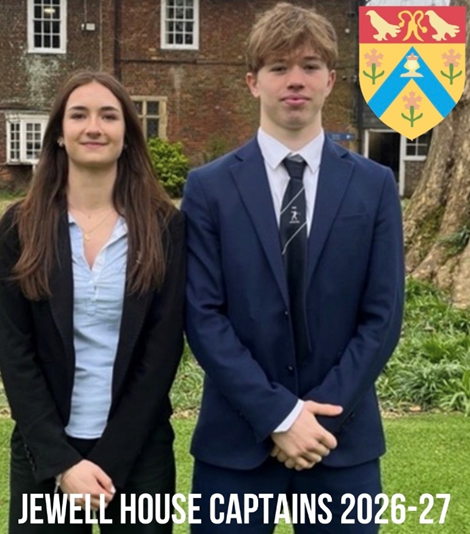
Jewell
House Captains: Tom and Daisy
Recent Honours: House Cup Winners in 2024
Known For: Exceptional participation in the smaller competitions, Jewell House are consistent scorers throughout the year.
About Bishop John Jewel: John Jewel (1522–1571), Bishop of Salisbury, was a leading figure of the English Reformation. Educated at Oxford, he supported Protestant reforms and fled to the Continent under Mary I. Returning under Elizabeth I, he became bishop in 1559 and wrote the influential Apology of the Church of England, defending Anglican doctrine against Catholic critics. A gifted preacher and scholar, Jewel helped shape early Anglican identity before his death in 1571.
What the House Captains say:
Tom: “I can’t wait to fulfil my role of House Captain this year and am extremely excited to organise some great events and competitions to get students from all years competing and enjoying their time here at BWS to the fullest! This role means a lot for me to be able to really reach out to all the years and help us across the House to work together to a shared goal!”
Daisy: “I’m really looking forward to being House Captain this year because I think it’s a great chance to represent our House and have fun within the school community! Over the next year I’m hoping to get more people involved in House events, organise a range of exciting competitions, and make sure everyone in the House feels included!”
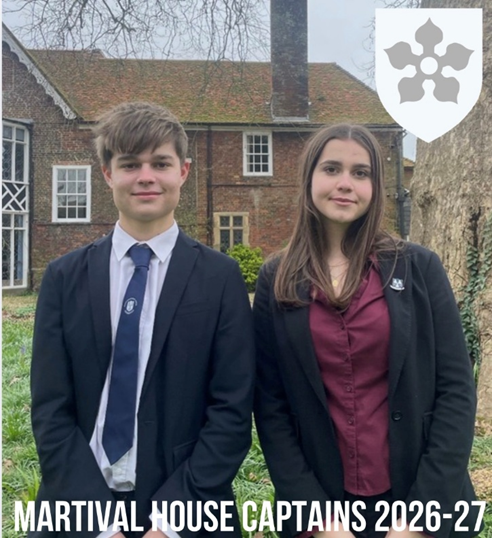
Martival
House Captains: Monty and Elodie
Recent Honours: House Cup Winners in 2025
Known For: The House with the most House Cup wins, Martival pride themselves on high participation levels, inspiring assemblies and strong performances throughout the year. After winning the 2025 House Cup in the final week, they will be looking to go for back-to-back victories this year.
About Bishop Roger Martival: Roger Martival (d. 1330), a prominent medieval churchman, served as Archdeacon of Huntingdon and Leicester before becoming Dean of Lincoln in 1310. He briefly held office as Chancellor of the University of Oxford (1293–1294). Elected Bishop of Salisbury in June 1315 and consecrated that September, he oversaw one of the best‑kept episcopal registers of his era. Martival served until his death on 14 March 1330 and is commemorated at Bishop Wordsworth’s School.
What the House Captains say:
Monty: “I am proud to uphold the Bishops age-old tradition of House Captains, striving to ensure the best for every individual, not only in Martival house, but in the school as a whole. I hope that all those at BWS enjoy their year and look forward to arriving every morning, smiling and eager to learn. Along with Elodie, our aim this year is for every member of Martival to be involved in some form of competition or event to guarantee that Bishops feels like home and that they belong. I can’t wait to see what the year brings.”
Elodie: “I’m really excited to be House Captain because it’s such a fun opportunity to represent my house and bring everyone together. I want to help create a really positive atmosphere where everyone feels excited to get involved. This year, I’d love to get more people taking part in events, and make things as fun as possible so everyone feels proud to be part of Martival and so we can win the House Cup!”
Osmond
House Captains: Jared and Emma
Recent Honours: House Cup Runners-Up in 2024
Known For: Osmund House have been strong competitors in the early stages of recent House competitions but have fallen away in the final two months. Can they find the stamina to bring home their first House Cup?
About Saint Osmund: Saint Osmund of Salisbury (d. 1099), a Norman noble and nephew of William the Conqueror, served as England’s chancellor before becoming bishop in 1078. A key figure in both church and state, he helped compile the Domesday Book and completed the cathedral at Old Sarum. He organized a influential liturgy, later known as the Sarum Use, adopted across the British Isles. Canonized in 1457, his remains were later translated to Salisbury Cathedral.
What the House Captains say:
Jared: “I’ve been at Bishops since Year 7 and over that time I’ve grown to really value being part of Osmund. It’s been a big part of my school experience and becoming House Captain means a lot to me. I’m proud to represent my House and give something back. This year I want to bring people together by encouraging everyone to get involved in school events and I would love to help lead Osmund to win its first House Cup.”
Emma: “I'm very happy to be a House Captain of Osmund this year as it is a chance to encourage greater House participation and bring people together. I would like to focus on motivating and encouraging more people to get involved, regardless of skill level or experience. I want to make Osmund House a fun place to be, where people want to take part in house activities and are proud to be part of O. Although we've not had the best winning streak, I believe we can change this through teamwork and House spirit!”

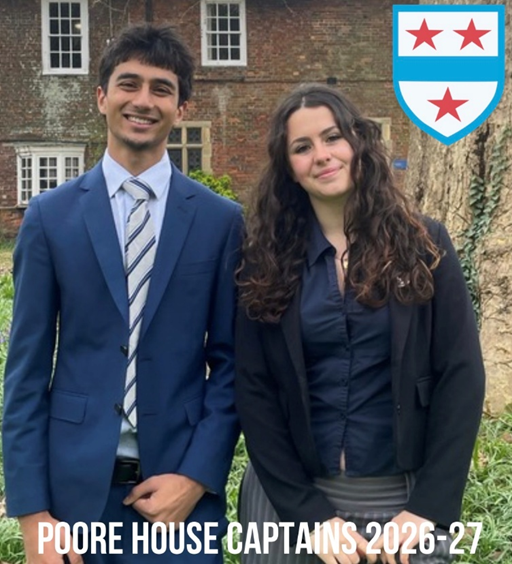
Poore
House Captains: Haroon and Kitty
Recent Honours: Sports Day winners in 2024 and 2025
Known for: Always a strong presence at Sports Day and House Music, Poore House are known for accelerating towards the finish line in the final straight of the House Cup.
About Bishop Richard Poore: Richard Poore (d. 1237), brother of Bishop Herbert Poore, was a learned medieval churchman who became Dean of Salisbury in 1197 and later Bishop of Chichester, Salisbury, and Durham. As Bishop of Salisbury from 1217, he initiated the move from Old Sarum and began building the new Salisbury Cathedral, laying its foundations in 1220. He shaped liturgy through works like the Consuetudinarium and helped organize the new city. Poore died in 1237 at Tarrant Keyneston.
What the House Captains say:
Haroon: “What makes me most proud to be House Captain is representing a House I genuinely care about — it’s great to be working with you all. Looking back, it feels surreal; it doesn’t seem long ago I was sitting in my first House assembly. Jack and Grace have left big shoes to fill, and I hope to do them and all past captains proud. Expect some top-tier events — good vibes, big energy, and everyone involved, as Kitty and I aim to bring the House Cup back where it belongs.”
Kitty: “I really can’t wait to be House Captain with all the exciting events and opportunities to work with our whole school community, supporting P House and making sure everyone feels happy and included! This year, I want to bring a fun, positive atmosphere that encourages participation for all so we can bring everyone together and strive to win the House Cup!”
Ward
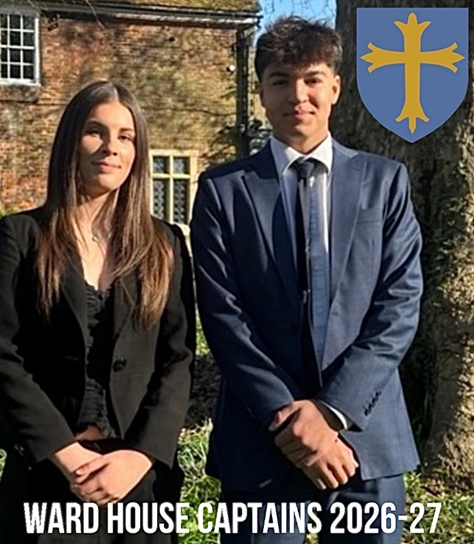
House Captains: Kaleb and Eve
Recent Honours: House Cup Winners in 2023
Known for: The newest House at Bishop Wordsworth’s School, Ward House have become strong performers on the big stage, seeing success in the high tariff competitions before taking home their maiden House Cup in 2023.
About Bishop Seth Ward: Seth Ward (1617–1689) was an English mathematician, astronomer, and Anglican bishop. Educated at Sidney Sussex College, Cambridge, he became Savilian Professor of Astronomy at Oxford and a founding fellow of the Royal Society. Appointed Bishop of Exeter in 1662 and translated to Salisbury in 1667, he enforced conformity laws and spent heavily restoring Salisbury Cathedral. A noted opponent of nonconformists and supporter of scientific learning, he died in 1689 at Knightsbridge.
What the House Captains say:
Kaleb: I am extremely proud to be one of the Ward House Captains this year as I have been a part of this House since year seven and I cannot wait to fulfil this role to the best of my ability. I can’t wait to organize great events, inspire students and help them to enjoy their time at Bishops to the fullest. I think it’s particularly important for younger years to fully involve themselves in activities and competitions as it instils a sense of teamwork within our house right from the get-go.
Eve: I am so excited to be Ward House Captain and cannot wait for what Kaleb, all of W, and I are going to bring to Bishops Wordsworth's this coming year. I would love for Ward to have the highest participation in events and the biggest House spirit in the school. Following from the past House Captains, we want to try and get Ward as close to the House Cup as possible! I hope that everyone in W House will enjoy their time at BWS as much as possible with Kaleb and I as House Captains.
Houses at BWS: A short history
BWS started in the Bishop’s Palace, moving to the Chapel Block Building on Exeter Street upon completion in 1890. The school also acquired the use of accommodation for boarding houses at both Exeter Street and Grosvenor Terrace. When the Bishopgate Building was completed in Easter 1904 this was used for both the Headmaster’s House and as a boarding house. In September 1904 a large house in the Friary was acquired as a girls’ boarding house and the use of this building by the school continued until the girls departed for their new school.
The only reliable early records of the school’s life are the accounts of Reuben Bracher’s speeches from Prize Giving; these are recorded as summaries from 1890-1927, but in them no mention is made of a House System. The first copy of the Wordsworthian in the archives dates from 1915, and this gives a fuller picture of life at Bishop’s. At this time, there were Junior and Senior Preparatory Departments, with the Senior School then being divided into a, b & c divisions, some of which were single-sex and some mixed. In 1916 mention is made of a ‘g’ form in each year (girls only), and then from 1919 an ‘m’ (matriculation) division is introduced. These form designations appear to have been purely for administrative convenience rather than generating a strong sense of identity amongst the pupils.
From 1925 new prefect and house systems were introduced for the girls, firstly to operate in the New Street Building and then extended to the rest of the school. The intention is explicitly given in the magazine – the girls (and one presumes the boys too) wanted more unity and identity, which were otherwise difficult to build given the scattered nature of the school’s estate. The four divisions (or houses) were given colours – Red, Green, Blue and Yellow, with two further colours (Purple and Brown) being added in 1926. At Sports Day in 1926 it is clear that there was healthy rivalry between the six houses, involving both boys’ and girls’ athletics.
In the 1935-36 Annual Record it states that it was decided to keep the episcopal tradition and to call them after four Bishops of Salisbury, Osmund, Poore, Martival and Jewell.
In September 2017 a fifth house was introduced as the lower school intake increased to 160 students per year. The new house has been named W