

Bishop Wordsworth's Church of England Grammar School
Reports & Academic Progress
At BWS we believe that students can only sustain rapid academic progress when they are provided with clear expectations, regular feedback, and a shared understanding of how well they are doing. Transparent reporting allows students, teachers and parents to work together in supporting learning, recognising success, and identifying where further effort or support may be needed.
The below sections explain how academic reporting operates at BWS, and what information families can expect to receive during the school year.
School Reports
Each student receives a written report three times each academic year. These are published via the My Child At School (MCAS) platform. The dates of these reports can be found in the School Calendar. All reports include:
- Attitude grades (see below)
- Current Performance Grade (see below)
One report each academic year will include written targets, which give advice to students on how to improve in each of their subjects. Reports in Years 10 to 13 will also include the Target Grade for each subject.
One report each academic year will include the percentage and grade achieved in an Internal Examination. These are published in the Summer Term for all years except Year 11 and 13, who receive these in the Spring Term.
Attitude Grades
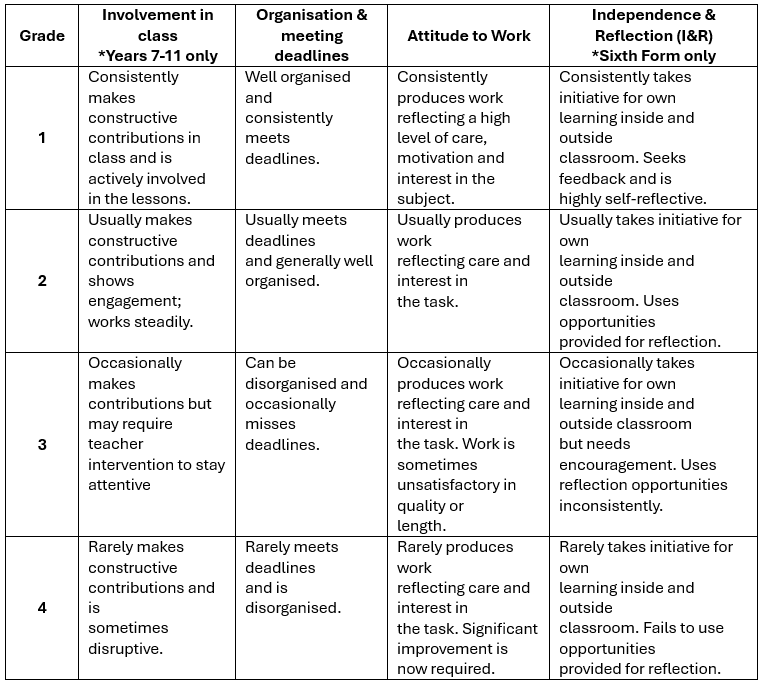
All students are awarded grades for their attitude in each subject on each of the three annual reports. Attitude is divided into 3 categories:
- Class Involvement
- Organisation and Deadlines
- Attitude to work
In Sixth Form, students are judged on Independence and Reflection instead of Class Involvement.
Each criterion is scored from 1 to 4, with 1 being the best grade. Descriptors can be found in the table below:
Target Setting
GCSE
GCSE Target Grades are set for all subjects at the start of Year 10. These are initially based on a student’s prior attainment at Key Stage 2. Teachers may modify Target Grades based on individual potential and the Target Grades are reviewed regularly throughout the GCSE course.
A Level
A level Target Grades are set at the start of Year 12. These are initially based on a student’s GCSE Average Points Score (APS), using national performance data. Teachers may modify Target Grades based on individual potential and the Target Grades are reviewed regularly throughout the A level course.
Teachers also provide UCAS Predicted Grades as part of the university application process. These are not the same as Target Grades.
Current Performance Grades (CPGs)
In Years 7 and 8, students are graded using Achievement Bands. These are named:
- Exceptional
- Confident
- Secure
- Developing
- Foundation
Broad definitions for each band can be found in the table below.
|
Attainment Band |
Broad definition (subjects will have their own specific descriptors) |
|
Exceptional |
Is able to synthesis ideas to deal with unfamiliar situations. Can use detailed knowledge and understanding to evaluate and analyse. Uses skills creatively. |
|
Confident |
Has detailed knowledge and understanding of the subject at this level, can use these to develop sensible solutions independently. Can select and use skills precisely and accurately. |
|
Secure |
Has good knowledge and understanding of a range of elements of the subject at this level and is beginning to show greater independence when finding solutions. Skills can be selected with some guidance and their use shows increasing accuracy and precision. |
|
Developing |
Is starting to show broader knowledge and understanding of the subject at this level and can offer solutions in familiar situations. Has greater familiarity with different skills and can employ them with some accuracy. |
|
Foundation |
A discretionary band, to be used where a student’s performance in that subject is a cause for concern. |
Departments assign bandings adhering to set proportions, with a degree of flexibility built in to allow for professional judgement. As such, the bandings represent a student’s performance relative to their peers. The purpose of this is to make the bandings comparable across different subjects.
Approximately two thirds of students will be assessed as being in the “Secure” and “Confident” bands. Approximately one sixth will be assessed as “Developing” and one sixth as “Exceptional”. “Foundation” is a discretionary band, to be used where a student’s performance in that subject is a cause for concern.
In Years 9 to 11, CPGs are awarded using the 9-1 GCSE grading system. In Years 12 and 13, CPGs are awarded using the A*-E A level grading system. The CPG indicates the expected outcome at the end of the course if the student maintains their current rate of progress. It does not indicate the grade a student would achieve if they sat the exam at this point. CPGs can be higher than Target Grades. However, if this performance was maintained, the expectation would be that the Target Grade is raised to reflect this.
Parents’ Evenings
Parent Consultation Evenings take place online once per academic year. The dates can be found in the School Calendar. Parents may book a 5-minute appointment with any of their child’s teachers with whom they wish to speak.
Parent evenings are currently conducted online through the SchoolCloud portal. Parental logins are accessed via this link. Once appointments are made parents will be emailed a link to the evening one hour before their first appointment. If you need any support check this link. To add a second parent to appointments already made, please follow this link.
Additional Invitation Consultation Evenings take place in Years 10, 12 and 13. These take place in school and parents will be invited to attend if there are concerns over their child’s progress.