Bishop Wordsworth's Church of England Grammar School
History
Introduction to the Department:
History is a rigorous academic discipline that develops students’ ability to analyse evidence, question interpretations, and construct well-supported arguments about the past. Through critical thinking and enquiry, students learn to evaluate sources, identify bias, and understand how historical narratives are formed. The BWS History curriculum aims to develop pupils’ curiosity about the past and their understanding of how historical events have shaped the modern world. Through carefully sequenced lessons, rich sources, and historical enquiry pupils build chronological knowledge and disciplinary skills such as analysis and interpretation. This coupled with the study of second order concepts, such as causation, significance, similarity and difference and change and continuity. Over the span of the course it is intended that BWS students gain not just historical depth but can also relate their learning to the evolving events around them, bringing empathy, knowledge and context to ongoing world issues.
Ypres Trip 2026


Recommended reading list:
- 1066: The Year of the Conquest – David Howarth. A highly readable narrative of the events leading to the Battle of Hastings (KS3)
- The Plantagenets: The Kings Who Made England – Dan Jones Dramatic storytelling about medieval kings and power struggles. (KS3)
- Liberty's Dawn- Emma Griffin. Human focused introduction, very accessible. (KS3)
- Black and British – David Olusago - Excellent narrative on Black British history. (KS3)
- The Third Reich in power-Richard Evans. Excellent, clear, text on this seminal period of European History. (KS4)
- Normal Women – Phillippa Gregory - Social history of women across 900 years. (KS4)
- Spies: The Secret Showdown Between America and Russia – Marc Favreau. Accessible cold war narrative non-fiction. (KS4)
- The Romanovs- Simon Sebag Montefiore. This is a vivid history of the House of Romanov dynasty, tracing how Russia’s rulers built and ruled a vast empire through power, intrigue, and violence until their dramatic fall in 1917. (KS5)
- Stalin: Court of the Red Tsar- Simon Sebag Montefiore. A real page turner, a colourful introduction to the intelligence and intrigue of Stalin’s regime. (KS5)
- The Penguin History of Modern Russia- Robert Service. An in depth but accessible narrative of the whole period. (KS5)
Extra and Super-curricular:
The department runs History Club and History Society both of which give students the space to explore historical themes that run outside of the standard curriculum. History Club is largely organised by Sixth Form students and in addition to medieval battle re-enactment(!) has several visiting speakers each year.
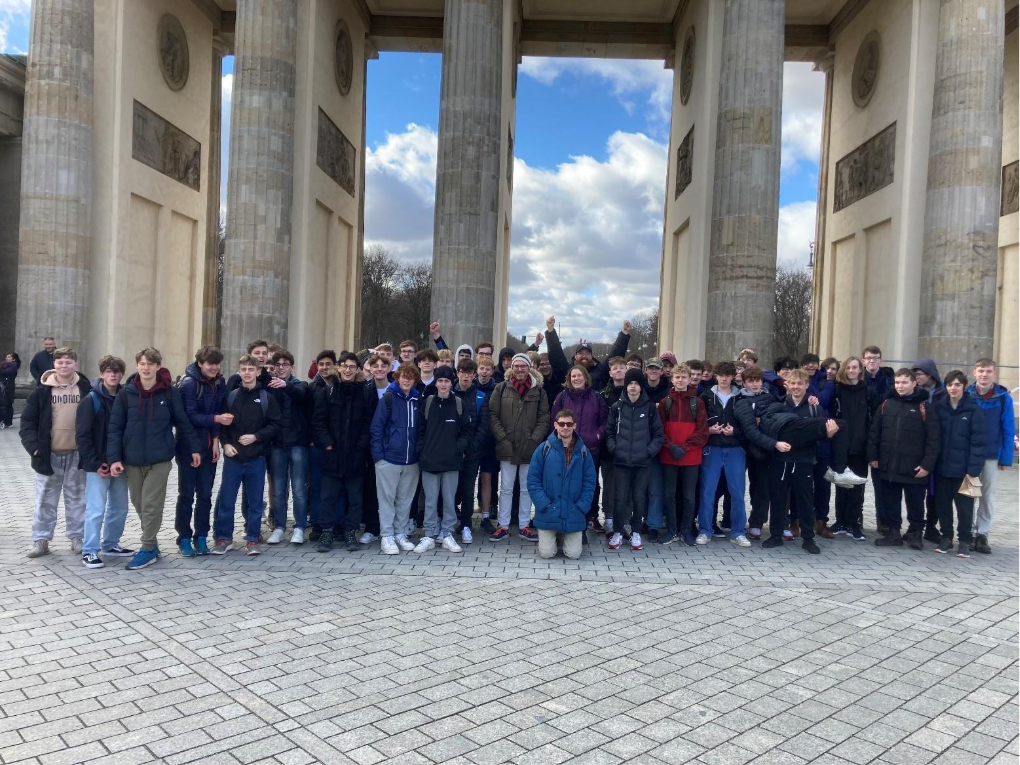
In addition, the History Department run residential trips in the GCSE including Year 9 and 10 Ypres and Berlin trips. These are designed to provide an immersive exploration of twentieth-century Europe, with classroom learning brought to life through visits to historically significant sites. Key locations include the Berlin Wall Memorial, Holocaust Memorial, Sachsenhausen concentration camp, and the Stasi and DDR Museums, where the realities of dictatorship, conflict, and divided societies are examined.
Results & Achievements:
Learning by Key Stage:
KS3
Key Stage 3 teaching focuses on the understanding of fundamental historical concepts and events. Year 7 begins with the Norman Conquest and moves through time to the Wars of the Roses and Tudors. Year 8 study the revolutions that shaped our world, and, in Year 9, pupils focus on how conflict and ideologies have. Year 9 content begins with the First World War and ends with the Cold War in preparation for GCSE. Assessments take the form of regular topic focused essays, source work, and knowledge quizzes.
KS4
At GCSE, through the AQA exam board, pupils focus on key historical themes through the study of Germany, Elizabethan England, Medicine Through Time and the Cold War. Students explore political change and the rise of dictatorship in Germany, alongside society and power during Elizabeth I’s reign. The Medicine course examines the development of medical knowledge and treatment from the medieval period to the modern day. Together, these topics develop students’ understanding of change, continuity, and historical significance. Assessments take the form of regular topic focused essays, source work, and knowledge quizzes. These are centre around source work and extent essay exam technique at a higher level than KS3.
KS5
The AQA A-Level curriculum focuses on The Making of Modern Britain (1951–2007) and Tsarist and Communist Russia (1855–1964) courses. Students examine political, economic, and social change in Britain from post-war governments to the early 21st century. Starting with Churchill’s post war government and ending with Coalition government. The Russia unit explores the fall of the Tsars, the rise of revolution, the development of the Soviet state, and how this state changes under Stalin and Khrushchev. Together, these topics develop deeper analysis of power, ideology, and long-term historical change. Each side of the course is taught by a different, specialist, teacher.
Assessment takes the form of regular topic focused essays and complex knowledge quizzes. These are centred around source work and extended essays. Non-Examined course work also contributes to A Level pupils’ final marks. This complex task is also practiced in Year 12.